Đăng ký nhận tin
Cảm ơn Quý khách hàng đã quan tâm đến An Huy Mỹ Việt.
Quý khách hàng vui lòng để lại thông tin liên hệ để chúng tôi hỗ trợ tốt nhất

Rising lending interest rates are creating new pressures on the real estate market – a sector heavily reliant on bank credit. While the government's policy is to control capital flows into speculative activities and prioritize the genuine housing needs of the people, the simultaneous adjustment of interest rates raises concerns about the true destination of credit capital.
Editor's note: As we enter 2026, the real estate market faces a new variable as lending interest rates show signs of rising sharply again after a period of maintaining low levels.
Since the beginning of the year, in official dispatches and meetings, the Prime Minister has emphasized the need to "manage monetary policy tools proactively, flexibly, promptly, effectively, and smoothly, without causing 'shocks' or 'abrupt changes,' and with a clear roadmap"; "strictly control speculative real estate credit, focusing on the actual housing needs of the people…".
However, in reality, despite some preferential policies such as credit packages for social housing, the adjustment of interest rates and credit flows into the real estate market is still being applied in a "one-size-fits-all" manner, lacking differentiation in terms of objectives, target groups, and product segments.
The reversal in interest rates occurred precisely when the real estate market had just undergone a period of legal deregulation and was beginning to show signs of supply recovery after the slump of 2022-2023, raising concerns about cascading consequences. The "pincer" of interest rates is poised to stifle liquidity, affecting investment activities, project development, and people's access to housing.
In a context where credit remains the primary source of capital dominating most market activities, the question is not just how to manage monetary policy, but rather the need to develop a comprehensive set of solutions combined with other tools and policies. Simultaneously, expanding and opening up other medium- and long-term capital channels becomes essential, while market participants must mature and learn to adapt to all possible scenarios.
Based on factual surveys, data analysis, and feedback from experts, businesses, brokers, and homebuyers, Reatimes is launching a series of articles titled "Credit for Real Estate: Cannot be Regulated in a 'Blank' Way," aiming to paint a comprehensive picture of interest rate trends, their impact on the real estate market, and propose solutions for more stable and sustainable market development in the coming period.
We are pleased to introduce this to our readers!
In recent years, in its operational guidelines, the regulatory body has repeatedly emphasized the need to control speculative real estate credit while prioritizing capital flows for genuine housing needs. However, the latest statistics show that the flow of credit into the real estate market still leaves much to be desired.
According to a report by the State Bank of Vietnam, as of December 31, 2025, outstanding credit to the real estate sector by credit institutions reached approximately VND 4.74 million billion, an increase of 36.24% compared to the same period in 2024. This is the fastest growth rate in the last three years and higher than the overall credit growth rate of the entire economy, which was 19.01%.
Notably, the real estate sector accounts for 25.53% of the total outstanding loans in the economy, indicating that it remains one of the largest capital-absorbing sectors of the banking system.
A closer look at the capital flow structure reveals a significant disparity between two groups: investors/project developers and individual buyers. Specifically, outstanding credit for real estate business activities – serving the corporate group – reached approximately VND 2.16 trillion, an increase of 49.55% compared to the same period in 2024 and accounting for 45.58% of total real estate credit outstanding.
Meanwhile, consumer spending on real estate – that is, capital flows serving personal needs for purchasing houses and land – reached VND 2.58 trillion, an increase of 26.79%, accounting for 54.42% of the total outstanding loans in this sector.
Thus, the growth rate of real estate business credit is twice as high as that of consumer credit. Although the proportions remain similar, the rate of expansion differs significantly. The question is: What does the structure of real estate credit flows reveal?
According to Associate Professor Pham The Anh, Head of the Economics Department at the National Economics University and Chief Economist at the Vietnam Economic and Strategic Research Center (VESS), the data reflects a trend of credit growth heavily skewed towards project development and real estate business purposes.
This is reflected in the significant increase in the number of approved projects, legal clearances, and new launches on the market in recent times. Statistics from VARS IRE indicate that in 2025, the entire market will have more than 128,000 new housing products offered for sale, the highest level in the 2019-2025 period and an 88% increase compared to 2024. Of these, apartments account for the majority with more than 80,000 new units, double the previous year.
Although there are no official statistics on the real estate segments receiving the most credit, based on the available data, it cannot be ruled out that capital continues to flow strongly into project development, especially in the mid- and high-end segments, leading to a situation where the product structure tends to be out of sync with actual demand.
Specifically, in Ho Chi Minh City last year, there were 10,000 mid-range apartments, 4,700 high-end apartments, and 2,000 luxury apartments, with almost no affordable housing units. In Hanoi, the difference is even greater with 646 mid-range apartments compared to 19,380 high-end apartments and 12,274 luxury apartments (1) . It can be seen that affordable housing products, which are the needs of the vast majority of people, are increasingly limited in supply.

The growth rate of real estate business credit is double that of consumer credit.
The imbalance in product structure is also partly reflected in housing price trends. According to data published by the Ministry of Construction, apartment prices in 2025 are expected to increase by 20-30% compared to the previous year. In Hanoi, the increase reaches 40%, with the average selling price reaching 100 million VND/m² , while in Ho Chi Minh City (formerly), the average new asking price is 111 million VND/m² , a 23% increase compared to the same period.
Conversely, the market also began to show signs of inventory accumulation. In the fourth quarter of 2025, the real estate inventory in projects was 32,894 units/plots, an increase of 23.7% compared to the previous quarter. In particular, the apartment type tended to increase its inventory in the last 6 months of the year (2) .
Looking at these figures, a paradox emerges: New supply continues to increase, credit flowing into real estate is also surging, but the market's absorption capacity is not keeping pace, especially in high-priced segments.
With real estate business credit growing significantly faster than credit for home purchases, the question arises: Who is benefiting the most from this capital flow? Where do homebuyers stand in the current real estate credit landscape?
According to data from the State Bank of Vietnam's report, credit programs aimed at supporting housing as directed by the Government still account for a very small proportion of the total capital flowing into the real estate market.
By the end of 2025, the total outstanding housing loan balance under these programs through the Social Policy Bank and commercial banks will reach approximately VND 41,000 billion. Of this, the five social housing loan programs through the Social Policy Bank will account for over VND 25,000 billion (including approximately VND 20,500 billion under Decree 100/2024/ND-CP detailing some provisions of the Housing Law on the development and management of social housing; and nearly VND 4,800 billion for eligible housing policy beneficiaries).
The remaining amount, approximately VND 16 trillion, is disbursed through commercial banks, including: VND 1,996 billion for the VND 30 trillion package to implement the housing support loan program under Resolution 02/NQ-CP; the social housing loan program under Resolution 33/NQ-CP; and other regular credit packages totaling VND 7,900 billion.
When implementing housing loan programs as directed by the Government, the State Bank of Vietnam adjusted interest rates seven times, gradually reducing them from 8.7%/year for developers and 8.2%/year for homebuyers to 6.1%/year and 5.6%/year respectively.
However, disbursement results remain quite modest despite a 167% increase compared to the same period last year. By the end of 2025, commercial banks committed to providing nearly VND 18,000 billion in credit, of which loan disbursements reached approximately VND 7,600 billion. Specifically, VND 6,349 billion was disbursed to investors in 46 projects, while only VND 1,251 billion reached homebuyers in 35 projects.
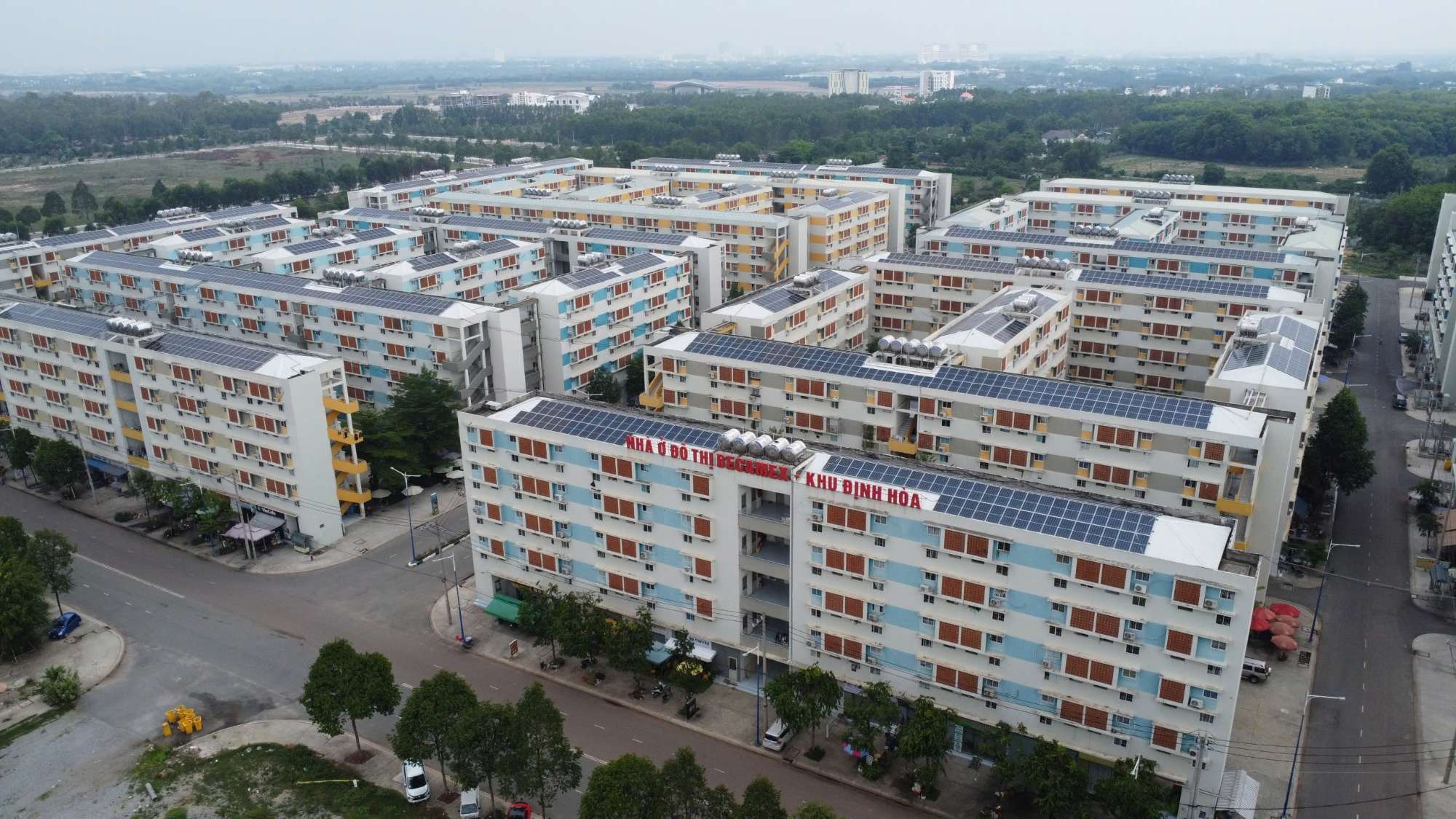
Credit disbursed to those purchasing social housing or covered by housing policies remains limited. (Illustrative image)
Another program expected to support young customers, the preferential interest rate package for those under 35 buying social housing, also recorded a very small scale, with outstanding loans in 2025 reaching only about 228 billion VND. Notably, by the end of 2025, major banks simultaneously stopped the preferential loan package for young people buying houses, while raising interest rates on new loans by 1-2%, which has now "aligned" with the soaring interest rates of the entire industry.
If we compare this figure to the scale of real estate credit, which exceeds 4.74 million billion VND, the proportion accounts for less than 0.005% – a very small amount in the total capital flow of the market.
Explaining these indicators, Associate Professor Pham The Anh said that the fact that credit capital has not reached those purchasing social housing or housing under housing policies stems from two main reasons.
Firstly, the supply of affordable real estate is relatively limited. While the social housing segment has met its 2025 target of 102,633 out of 100,275 units, the figures for Hanoi and Ho Chi Minh City are only 5,158 and 12,799 units respectively, which is insufficient to meet the enormous demand in these two cities. This lack of suitable supply leads to a situation where, despite low interest rates, people are reluctant to borrow from banks to buy houses.
Secondly, while regulations and eligibility criteria for purchasing social housing and accessing preferential credit packages have been significantly expanded over the past year, the number of eligible individuals remains limited. Furthermore, proving income for loans is a significant challenge for low-income individuals or those without stable employment.
"The biggest factor remains the lack of supply, not that people don't want to borrow or can't access it," Associate Professor Pham The Anh emphasized.
With homebuyers having limited access to preferential credit programs, the simultaneous increase in lending interest rates is raising concerns about people's ability to own homes, as well as the ripple effects on the market and the economy.
According to experts, without a clear distinction between different groups of borrowers, tightening credit or raising interest rates indiscriminately could put the greatest pressure on those with genuine housing needs and businesses developing affordable housing projects.
The policy of restricting real estate speculation loans and prioritizing loans for actual housing needs is not new, but how to direct credit flows to where they are needed is the real issue worth discussing.
Associate Professor Pham The Anh stated that the key to managing real estate credit lies not only in controlling the scale of capital flow, but also in clearly distinguishing between borrowers and the purpose of capital use.
“Controlling credit to the real estate sector is necessary; it's a prerequisite for the economy's resources to flow into production and business. However, it's crucial to differentiate interest rates between borrowers purchasing their first home and those purchasing their second, third, fourth, and so on. Credit flowing into investment real estate must be controlled. Currently, we have implemented a system of assigning unique identification codes to each property, making it possible to identify individuals borrowing to purchase multiple properties simultaneously. Such loans should not be encouraged. For those buying their first home, support policies are needed, regardless of whether it's commercial or social housing. Therefore, a differentiation in interest rates is necessary in the real estate sector to separate the needs for actual housing from those for investment,” Associate Professor Dr. Pham The Anh analyzed.
According to the expert, in the current context, with the real estate supply gradually recovering strongly after a period of stagnation, a simultaneous increase in interest rates will cause demand for housing to quickly decline.
"If mortgage interest rates reach 14-15% per year, it will be very difficult for people to dare to borrow money to buy a house. At that point, even those with a genuine need for housing will have to temporarily put their plans to own a home on hold ," said Associate Professor Dr. Pham The Anh.
From a market perspective, Mr. Vo Huynh Tuan Kiet, Director of Housing Market at CBRE Vietnam, believes that financial pressure on homebuyers is currently at a serious level, stemming from the simultaneous end of preferential interest rates and principal debt grace periods.
According to Mr. Kiet, in the initial phase, many customers enjoyed preferential rates of around 8% per year. However, when the preferential period ended and the interest rate switched to a floating rate of 13-15% per year, the actual cost of capital increased by 5-7 percentage points, creating a significant financial shock, especially for large loans.
This pressure is further exacerbated by a "double impact" when many loans simultaneously end their principal grace period and enter a higher interest rate phase. At that point, the borrower's monthly payment obligation can increase by 1.5 to 2 times compared to the initial preferential period.
"For households with fixed incomes, this change disrupts cash flow, increasing the risk of late payments and affecting credit scores at CIC, thereby making debt restructuring more difficult later," analyzed Mr. Vo Huynh Tuan Kiet.
According to this expert's estimate, as interest rates rise, approximately 15-20% of real estate loans incurred during 2023-2024 are at risk of falling into financial imbalance, especially among those who borrow to buy homes using high leverage.
Not only homebuyers, but also real estate developers are facing increased capital costs as interest rates rise. When input costs increase, real estate businesses often tend to keep selling prices high to offset financial expenses. However, in the context of declining liquidity, developers find themselves in a dilemma.
"High interest rates mean higher project development costs. Therefore, if developers don't lower prices, it will be difficult to sell, but lowering prices will narrow profit margins. The systemic risk is enormous if businesses cannot solve this difficult problem," Associate Professor Dr. Pham The Anh analyzed.

Rising interest rates across the board will cause demand for housing to decline rapidly. (Illustrative image)
From a macroeconomic perspective, Dr. Vu Dinh Anh, an economic expert, believes that in order to regulate real estate credit appropriately, the prerequisite is to determine the scale and contribution of the real estate sector to economic growth.
According to statistics, the average contribution of the construction and real estate industry to the total GDP of the country in recent years accounts for about 11%, of which the real estate industry directly accounts for about 4.5%, contributing an average of 0.5 percentage points to GDP growth (3) .
If we include the spillover effects on more than 40 other industries, real estate contributes 7.62% of the national GDP, thanks to its leading role in driving the development of many industries such as construction, tourism, accommodation - food and beverage, processing and manufacturing industries, finance - banking. It is estimated that when the final use demand of the real estate industry increases by 1 billion VND, the production value of the remaining industries will increase by 0.772 billion VND (4) .
In this context, experts believe that managing interest rates and credit for real estate needs to be done cautiously and in conjunction with tax policies, fiscal policies, specific policies for each target group/segment, and measures to regulate supply and demand in the market. Otherwise, not only will real estate entities and the market be affected, but it could also lead to repercussions for many related economic sectors.
How can credit policies both curb speculation and avoid restricting people's access to housing and the capital of businesses developing projects? Readers are invited to read Part 3, published on Reatimes !
Communications by An Huy Group

Cảm ơn Quý khách hàng đã quan tâm đến An Huy Mỹ Việt.
Quý khách hàng vui lòng để lại thông tin liên hệ để chúng tôi hỗ trợ tốt nhất